This conference takes design as an object and a theme to gain new perspective on the study of race in American consumer society. How has racialized imagery sustained the work of capitalism and American dreams of the “good life”? Considering design in relation to problems of self-fashioning, material culture, immigration, urban and suburban development, and decorative commodities, we will engage with the latest scholarly conversations about race and capitalism and explore paths for future inquiry. Ultimately the conference aims to uncover the otherwise “invisible” cultural logics and historical processes that have woven racial difference into the fabric of American life.
I’ll be presenting some preliminary research on first communion portrait photography and the material culture of Nuyorican migration as part of the panel “Life Design” on Thursday morning, October 24. The conference and related exhibition, “Race and the Design of American Life,” will take place at Special Collections Research Center at Regenstein Library.
View the full schedule and register online. [link]
Yesterday, Lincoln Mullen‘s tweets (and some great responses) about sources for the study of “U.S. children’s religion” got me thinking about the ways in which the projects I’m working on increasingly flirt with the small but growing literature on religion and childhood.
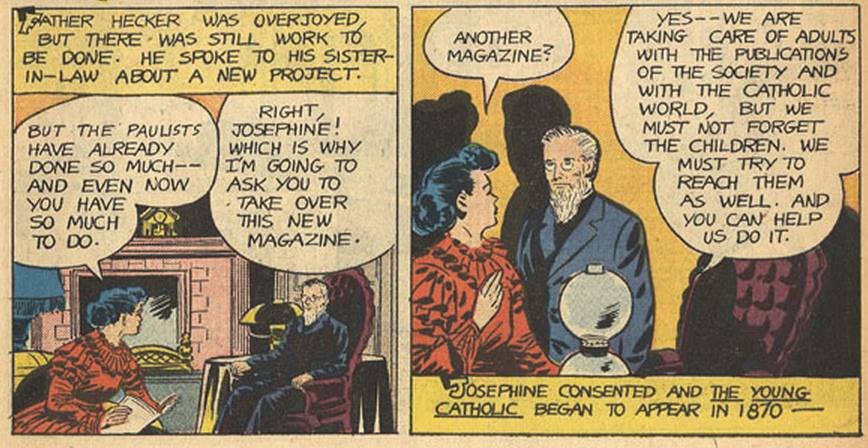
Certainly, for the middle-class Catholics I study, providing children with new, distinctively “American Catholic” reading materials was the impetus for a wide range of new publishing ventures in the 1870s and 1880s. [Some readers will note this is also the era of the Baltimore catechism, published in 1885.] Right now I’m writing on Isaac Hecker’s lesser-known labor of love, The Young Catholic, a monthly paper for children founded in 1870, and edited by his sister-in-law, Josephine Hecker. Yes, that’s her here, documented in a 1957 issue of the Catholic comic book series, Treasure Chest of Fun & Fact (digitized by the CUA Archives).**
The Young Catholic provided children in Catholic academies and Sunday schools with games, stories, and the chance to see their names in print — all under the warm, loving guise of a fictional editorial family: columnists “Uncle Ned,” “Aunt Jane,” and a host of “cousins” meant to be understood by readers as running the show (and providing Josephine Hecker relative anonymity). But back to Twitter. Lincoln made a good point point — we talk about children in terms of education, but how are they understanding religion? How do they participate in the making of their own religious subjectivity?
Portrait, 1950s. Collection of the author.
I don’t have the answers to these questions yet, of course, but the other reason I’ve been thinking about childhood lately is a conference paper I put together for the upcoming University of Chicago conference “Invisible Designs: New Perspectives on Race and American Consumer Capitalism.” Thanks to a cache of found photography and a personal interest in midcentury Nuyorican memoirs, I’ve become increasingly fascinated by the visual and religious worlds of Puerto Rican Catholics in twentieth-century New York. At the conference, I’ll be speaking about First Holy Communion portrait photography, and the intersection of religious and commercial impulses in El Barrio. And now that the Archives of the Archdiocese of New York is back open to the public, this conference paper may spin itself into an article…someday. I have a dissertation to finish, after all!
In Chicago October 24-25? Join us at Regenstein Library for the conference and visit the new exhibit, “Race and the Design of American Life.” The conference schedule is now online [link].
My latest post for Religion in American History considers sources for teaching religion in the history of U.S. sexuality. What have I missed? Join the conversation over at RiAH.
In addition, I’m thrilled to be named a Junior Fellow of the Martin Marty Center for the Advanced Study of Religion at the University of Chicago Divinity School for the 2013-2014 academic year. As a Marty Fellow, I’ll be completing my dissertation and teaching a course on U.S. women’s history in Spring 2014.
I’m delighted that a panel I organized for the 2014 Berkshire Conference on Women’s History (aka the Berks) has been accepted. Collecting on the Edges: Gender and Sexuality in the University Archive will feature not only our efforts at the University of Chicago to build new archival collections in gender and sexuality, but also the work of graduate students, faculty, and librarians at repositories including the Women & Leadership Archives at Loyola University Chicago, the Pride Library at the University of Western Ontario, and the Transgender Archives at UVic.
Through collection profiles and explorations of queer and archival theory, we will highlight how sexuality has been hidden in established University archives, and can become a new collections priority at our institutions. In doing so, we hope to explore issues of public engagement in LGBT history, the role of archives in mediating knowledge of this history, and the challenges and opportunities of partnering with University repositories.
To showcase the ongoing work of the project, we’re starting to collect our thoughts on tumblr. Over time, we’ll use it as a space to share findings and highlight the courses, programs, undergraduate student work, and public history stories associated with the larger world of history of sexuality research.
As part of my work for the Closeted/Out project, I have been organizing a series of workshops that bring visiting scholars to campus to join us in ongoing conversations about the role of gender and sexuality studies in public history theory and practice. Previous talks have featured Jennifer Brier, Associate Professor of History and Gender & Women’s Studies at the University of Illinois-Chicago (and a recent NEA grant recipient for her Mobile Museum!), and Tim Stewart-Winter, Assistant Professor of History at Rutgers-Newark, where he is also a steering committee member of the Queer Newark project. This Thursday, May 30 at noon, we’re thrilled to welcome Nan Alamilla Boyd, Professor of Women and Gender Studies at San Francisco State University, to discuss her recent edited volume, Bodies of Evidence: the Practice of Queer Oral History(Oxford UP, 2012).
For more information on Professor Boyd’s visit (and to RSVP), visit the CSGS Event Calendar.



 Monica L. Mercado, Ph.D.