This semester at Colgate, I’ve revised my upper-level History course, HIST 304 | Sex and Sexualities in U.S. History. In a few weeks, I’ll be chairing an excellent panel of scholars on a research panel on Sex and Religion, sponsored by S-USIH,the Society of US Intellectual History. The panel will take place on Zoom March 1 at 7pm eastern [you can register in advance, here].Continue reading “Teaching Sex and Sexualities in U.S. History”→
This year, I’m teaching one course at Harvard Divinity School while finishing my book manuscript, and it’s the course I’ve always wanted to teach: Women and Gender in American Catholicism. Check out the syllabus online and let me know what you would add — I had to cut so much good, new, work in this thriving subfield off of the official reading list, but I hope my students will make a dent with their writing projects!
Thanks to a Faculty Development Council Bicentennial Research Grant, I’ve been adding new content on women’s education and the history of coeducation to HIST 211: Women’s Rights in U.S. History (#colgatewmnhist). Colgate History’s social media team captured my students doing what they do best.
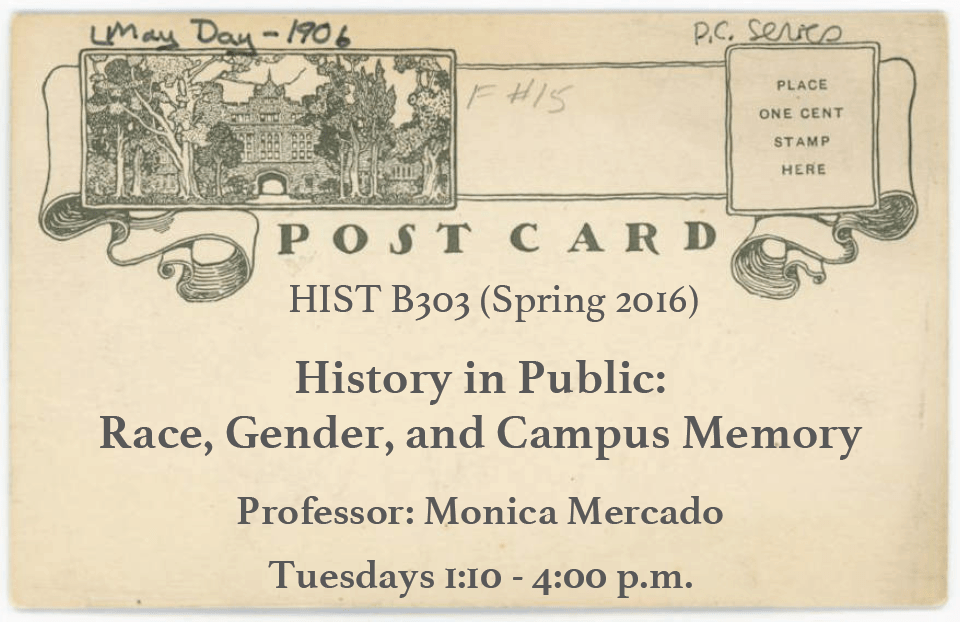
How do you teach campus history? In just a few week’s time, visitors will have access to a more robust course website; for now, see the course description here.
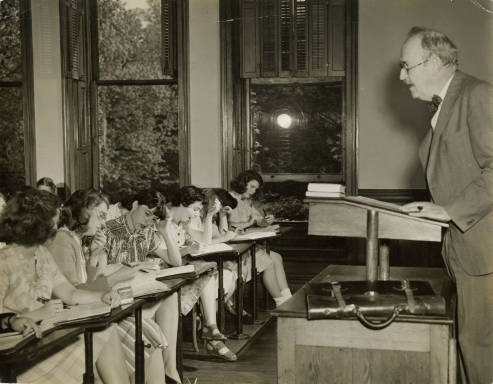
Professor Samuel Clagget Chew’s Bryn Mawr College classroom, undated, via Triptych.
This semester I’m back in the classroom, teaching a History Department seminar, “Higher Education for Women: Bryn Mawr and Beyond.” With apologies to Professor Samuel Claggett Chew (pictured left), my class of smart Bryn Mawr third- and fourth-years looks absolutely nothing like the lecture class of old. We divide our time between the classroom, Special Collections, and a course blog** linking past and present.
That blog, along with links to my syllabus and digital resources, is now live:
Although my students aren’t tweeting this semester, I’m tracking my class prep on Twitter (reviving the hashtag #bmchistory) and I look forward to using this space for reflecting on teaching the course and the research that it inspires.
** Students were given the option to blog anonymously, although no student has yet to choose this option. On student privacy and class blogging (or other instances of student work online that may be publicly visible), I’ve consulted this list of resources collected by Whittier College DigLibArts.



 Monica L. Mercado, Ph.D.